Glass Clock: Visible, ticking, breakable.
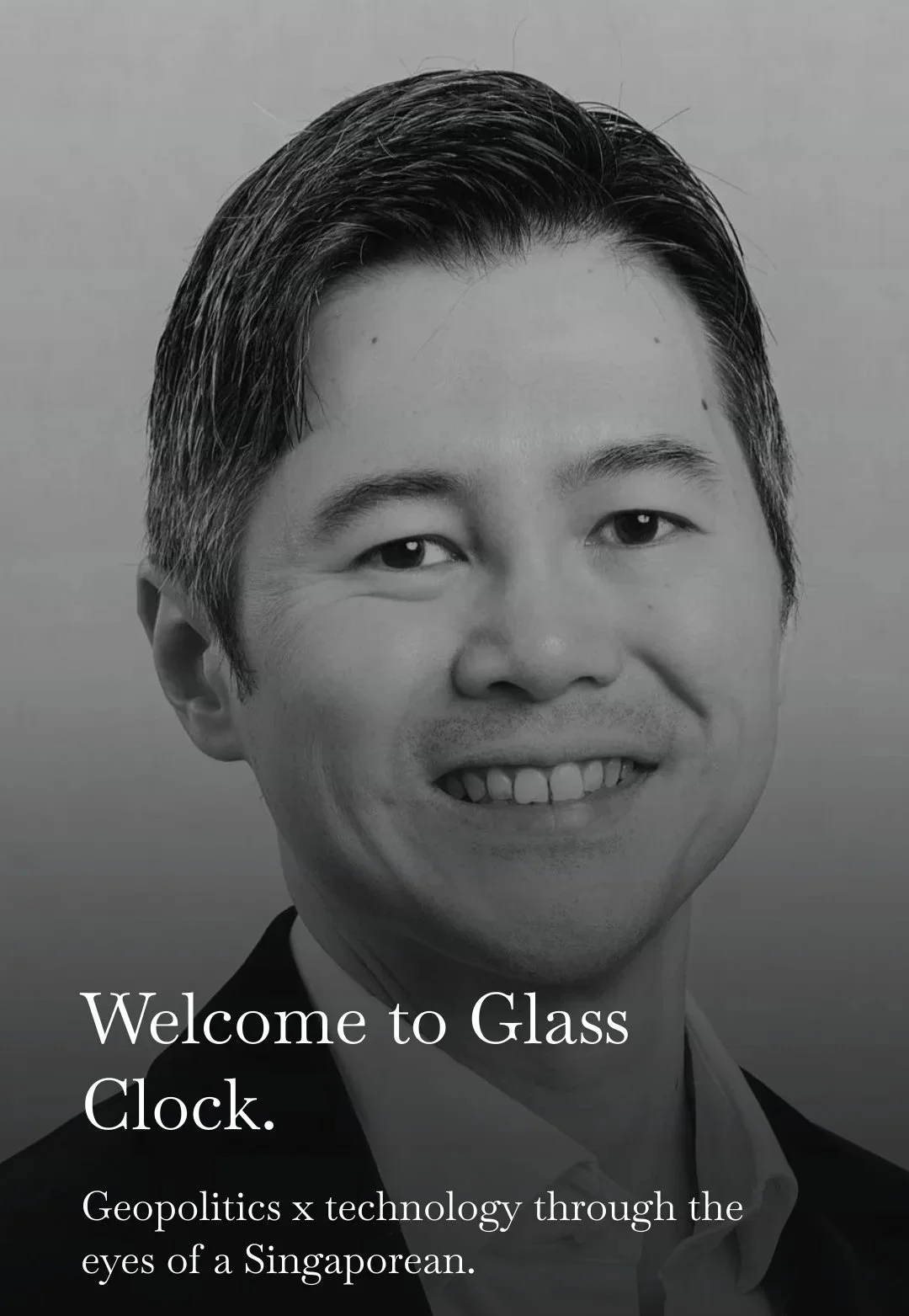
Hello, I'm launching Glass Clock, a substack publication on geopolitics x technology. Here, I’ll attempt to reflect on what happens when AI and digital systems compress decision-making and signal-to-action, creating an illusion of clarity in strategic conditions that remain fundamentally opaque. And that's the condition international relations is entering.
Glass Clock is also where I'll share ongoing research from my studies at King's College London's Department of War Studies, working through questions like - How do smaller states preserve autonomy when great powers compete? How does technology alter deterrence, escalation, coercion, and alliance behaviour? When does visibility create stability - and when does it create the false confidence that precedes kinetic escalation?
I'll write primarily from Singapore and the Asia-Pacific vantage point on topics ranging from AI capabilities and governance to cyber defence, energy security, digital sovereignty, media infrastructure, and population health. If you're someone trying to understand the world as it is rather than as we wish it were - you're welcome to subscribe.
Glass Clock countdowns.

#1. Securing the sovereign foundations of Singapore’s AI economy (The Business Times, 19 May 2026.)
For Singapore, AI sovereignty is the practical task of ensuring that dependence on others cannot be turned against us, while preserving our ability to run the economy on our own interests. In the AI era, these dependencies include – among other key inputs – an assured access to AI models, tokens and compute capacity. As the government acts on the ESR, it should therefore approach our AI-enabled economic transformation as two parts: upgrading skills and businesses on the surface; and, beneath that, building a sovereign foundation that cannot be arbitrarily cut off or priced out of reach. That is a structural mandate for national leadership – and not a problem that individual companies or workers alone can solve.